
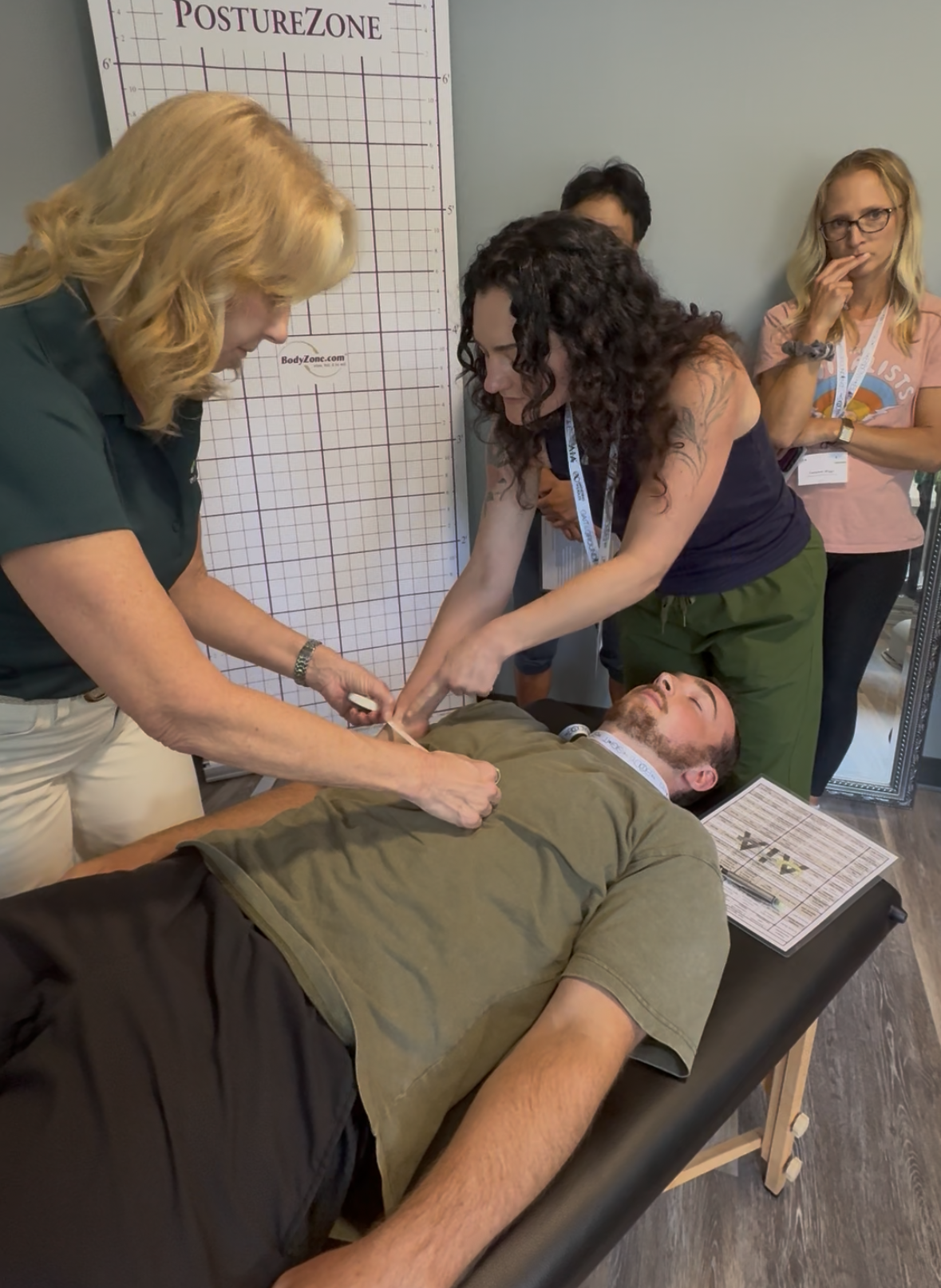
I just took my first course through the Applied Integration Academy (AIA) this past weekend in Boston; it was their flagship course for practitioners that work with the body called Gait & Grounding. I have a substantial background with the Postural Restoration Institute (PRI), which sparked a new way of thinking about human movement and has changed my life. AIA branched off of PRI and has simultaneously evolved and simplified course material, not an easy task. The following are a few major objective differences I have noticed between the two adjacent schools of thought, with subjective anecdotes mixed in.
- Foundation concept disagreements
PRI believes that all humans are biased towards a pattern that drives our center of mass towards the right, leading to overactive neuromuscular patterns, or polyarticular chains, coined as the Left AIC, Right BC, and Right TMCC. This thought process was derived from the common compensatory pattern by Dr. Gordon Zink where the following joint actions took place in the majority of people.
Occipito-atlantal (OA) junction: Rotated left
Cervicothoracic (CT) junction: Rotated right
Thoracolumbar (TL) junction: Rotated left
Lumbosacral (LS) junction: Rotated right
PRI polyarticular chains (2 of each, left and right)
.

PRI popularized the anatomical basis for these patterns: a few being the right diaphragm that attaches lower on the lumbar spine (and is stronger), a heavy liver on the right side, and cortical predominance of the left hemisphere of the brain (and the right side of the body). All humans may come into this world with this bias, but navigating an individual’s unique life demands with their own unique genetic and structural predispositions likely will lead to a wide variety of outcomes.
AIA noticed that many patients did not fit into the typical PRI pattern. A common phrase used in the industry is that people use “mental gymnastics” to reinforce their dogmatic beliefs. They developed a “Spectrum of Lateralized Patterns”, based on objective table tests. Simply put, depending on the orientation of a joint, you are likely either lateralized to the left or the right at that given junction. Then, putting together a picture of lateralization biases throughout the cranium, neck, ribcage, pelvis, ankles, and entire body, you can determine whether people are in one of four (#’s 2-5 on the chart) patterns:
Intact Left Lateralized Pattern
Non-Intact Left Lateralized Pattern
Non-Intact Right Lateralized Pattern
Intact Right Lateralized Pattern
I myself have benefited to a greater degree from AIA “Right grounding” exercises than I ever have with PRI “Left stance” related exercises. I have a harder time compressing into the right side and I feel like my left side is bearing more load. I now believe that before I learn to go left, I need to occupy and escape the neurologically dominant right side. My postural patterns never fit the Left AIC, with a lower left shoulder and a right cranial sidebend being two obvious indicators.
- Sagittal or Transverse, which to address first?
PRI teaches a sequential order of addressing complex postural adaptations, always starting with the sagittal plane via inhibition of the spinal erectors and activation of deep abdominal musculature through an exhale (internal obliques and transverse abdominis). Next to address is frontal plane “stability” – most notably in the left pelvis and thorax via the left ischiocondylar paired with the anterior fibers of the left gluteus medius and the left abdominals, taught in the myokinematics course. Once these boxes are checked, rotation in the transverse plane can be addressed. This approach works for certain individuals, but is often difficult or impossible to “keep hold of” these prerequisites, before addressing rotation (IR/ER) for myself and clients with complex cases.
AIA approaches this problem through the idea that the underlying mechanism for increased extension is rotational discord. Put differently, the body responds to rotational dysfunction with extension – the predominant compensatory strategy to manage gravity. We extend to increase airflow capabilities with accessory breathing musculature, stemming from a lack of rotary ability.
AIA teaches treatment for extension/lateralization patterns by incorporating 3D rotational movement profiles, specifically the serratus anterior and the glute max. Synchronicity of these muscles paired with compression of the left, right, or left and right, and breathing restore rotational ability for the thorax and pelvis.
Everything is rotation. Human movement doesn’t happen in a vacuum; flexion/extension and adduction/abduction occur with transverse rotation – they cannot be separated. AIA references Fryette’s 3 laws of spinal mechanics. When the spine is relatively neutral, side-bending to one side is coupled with rotation to the opposite side (first law); while when the spine is in flexion or extension, side-bending is coupled with rotation to the same side (second law). The third law is that motion introduced in one plane of spinal movement will modify the movement available in the other two planes. Law 3 stands out to me when referring to AIA’s treatment approach, as introducing rotation (paired with compression) first, will modify the ability to side bend and move in the sagittal plane.
- Coaching simplicity and pedagogy
PRI activities are quite complex and require high attention to detail for the practitioner and the patient. I’ve heard PRI practitioners before say that every part of a given positional breathing drill must be done perfectly to yield the desired benefits – this is a lot of pressure to perform on an exercise that is designed to change respiratory and neuromuscular dynamics in a parasympathetic state. Attention to detail is clearly important, but I have always struggled with this perfectionism mindset – especially as my main target population is those with Cerebral Palsy, where cognitive deficits may be present.
AIA takes a much more laid back approach to cueing, there are hardly any absolutes. The exact angle of a given segment is not important; if changing how you are positioned results in a greater ability to sense (compression), then it is encouraged. AIA explained the reasoning for this through the alpha and gamma motor neurons (lower motor neurons located in the ventral horn of the spinal cord). Alpha motor neurons innervate extrafusal muscle fibers which produce muscular force, AIA associates them with overcoaching, creating tension, and neuroticism. Gamma motor neurons innervate intrafusal muscle fibers which adjust the gain of muscle spindles, described by AIA as subconscious, predictive information to the brain through fascia.
I like the distinction between conscious motor control and subconscious predictive motor organization, but am unsure about evidence supporting this description of and distinction between alpha and gamma motor neurons. Alpha-gamma co-activation occurs when you voluntarily contract a muscle (PRI primary course approach), but using reference centers (PRI advance course approach) or sensations of compression (AIA), muscle spindle sensitivity is likely altered to a greater degree. It is also likely that it is possible for the practitioner’s energy and cueing to bias someone towards adjustments in muscle spindle sensitivity from a “laid back approach”, versus being biased towards producing greater muscular force through perfectionism.
I have great love and respect for all of the teachers, mentors, and peers I have met so far through PRI and AIA. I am not here to pick sides, but simply to better understand human movement. Comparing the two most influential continuing education models that I have seen is a helpful way to grow. New organizations of evolving practitioners stood on the shoulders of giants (PRI) to see further and make new discoveries.



Leave a Reply